From Energy Monitoring to Energy Intelligence: The Next Step for Australia Smart Buildings
20 June 2026 · BES Team
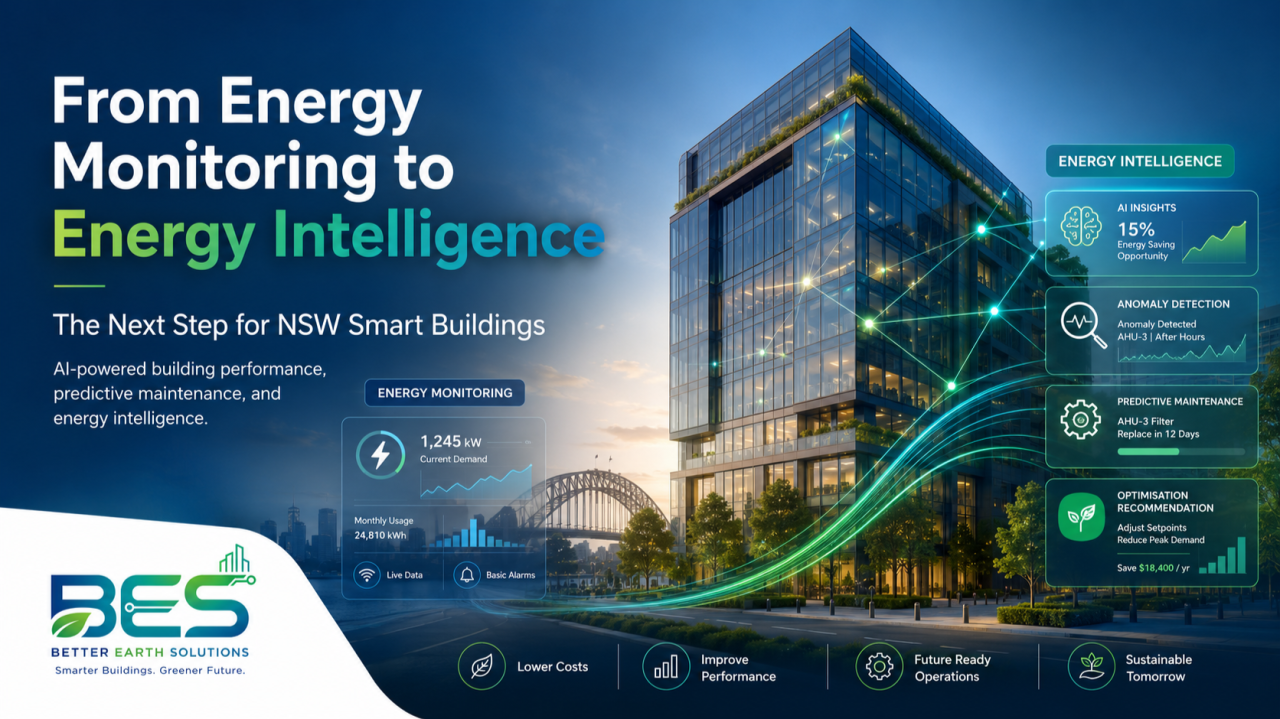
For many buildings, energy monitoring is no longer new.
Most modern facilities already have some form of metering, dashboard, BMS data, utility bills, or sustainability reporting process. Yet many building owners and facility managers still face the same practical challenge:
They have data — but not always decisions.
A dashboard can show what happened. A meter can show how much energy was consumed. A report can show monthly performance.
But the real question for today's building operators is different:
What is abnormal? Why is it happening? What should we do next?
This is where the industry is moving from energy monitoring to energy intelligence.
Why this matters for Australian buildings
Commercial buildings are a major part of Australia's energy and emissions challenge. Offices, schools, hospitals, hotels, industrial premises, retail spaces, and other non-residential facilities all consume energy every day to support comfort, operations, productivity, and safety.
As energy costs, climate commitments, ESG expectations, and building performance requirements continue to increase, building owners and facility teams are under pressure to do more than simply monitor consumption.
They need to:
- Reduce unnecessary energy waste
- Improve building performance
- Detect abnormal operation earlier
- Support sustainability and carbon-reduction goals
- Maintain reliable electrical and mechanical assets
- Make better operational decisions with limited time and resources
In NSW, this is especially relevant as the built environment continues to transition toward smarter, lower-emission, and more performance-driven operation.
The limitation of traditional energy monitoring
Traditional energy monitoring is useful, but it often stops at visibility.
A typical energy dashboard may show:
- Daily or monthly electricity consumption
- Peak demand
- Meter trends
- Building-level energy use
- Basic comparison against previous periods
These are important starting points. However, visibility alone does not always tell the facility team what action should be taken.
For example:
- A building may use more energy this week — but was it due to weather, occupancy, extended operating hours, equipment fault, or control settings?
- A chiller may be consuming more electricity — but is it due to higher cooling demand, reduced efficiency, poor sequencing, or abnormal operation?
- A switchboard or electrical asset may show early signs of stress — but is the trend normal, load-related, or a potential maintenance risk?
- A peak demand event may occur — but was it avoidable through better scheduling or load management?
This is the gap between data display and engineering insight.
What is energy intelligence?
Energy intelligence means turning building data into operational understanding.
It goes beyond monitoring by using analytics, AI, engineering rules, and contextual information to interpret what is happening inside a building.
A strong energy intelligence system should help answer five practical questions:
- What is normal for this building?
- What has changed?
- Why has it changed?
- What is the operational or financial impact?
- What action should be taken?
This requires more than a dashboard. It requires structured data, baseline modelling, abnormality detection, and engineering interpretation.
The role of AI in smart building performance
AI can play a powerful role in building performance when it is applied correctly.
In a smart building environment, AI can help identify patterns that are difficult to detect manually, such as:
- Abnormal after-hours energy consumption
- Equipment operating outside expected patterns
- Energy use not aligned with weather or occupancy
- Repeated peak demand events
- Load imbalance or unusual electrical behaviour
- Early warning signs of asset degradation
- Energy drift over time
- Inefficient equipment scheduling
The value of AI is not simply automation. The value is helping facility teams focus attention on the right issue at the right time.
Instead of asking operators to review hundreds of data points, an intelligent system should highlight:
"This is unusual. This is the likely driver. This is the recommended next step."
That is the difference between more data and better decisions.
Why baseline modelling is essential
One of the most important foundations of energy intelligence is a reliable baseline.
Without a baseline, it is difficult to know whether a building is performing well or poorly. A simple comparison against last month is often not enough because building energy use can change due to weather, occupancy, operating hours, tenant behaviour, or equipment schedules.
A better approach is to develop a performance baseline that considers factors such as:
- Cooling degree days
- Weekday, weekend, and public holiday patterns
- Operating schedules
- Occupancy-related changes
- Historical energy consumption
- Building load profile
- Major plant operation
- Known operational events
Once a reliable baseline is established, the building can be monitored against expected performance.
This makes it easier to identify abnormal energy consumption, quantify deviation, and prioritise investigation.
From sustainability reporting to operational improvement
Sustainability reporting is important, but reporting alone does not reduce consumption.
For building owners and facility managers, the real value comes when energy and sustainability data are connected to daily operations.
This means using data to support actions such as:
- Optimising plant schedules
- Reducing unnecessary after-hours loads
- Identifying abnormal base-load consumption
- Improving chiller and HVAC operation
- Detecting poor equipment sequencing
- Managing peak demand
- Prioritising maintenance based on risk
- Supporting NABERS readiness and performance improvement
In other words, sustainability improvement should not only be a reporting exercise. It should become part of the operating rhythm of the building.
Why facility teams need actionable intelligence
Facility teams are already busy. They manage comfort complaints, contractors, maintenance schedules, compliance, breakdowns, safety issues, tenant expectations, and budget constraints.
The last thing they need is another dashboard that simply adds more information without clear prioritisation.
A useful energy intelligence platform should provide:
- Clear abnormality alerts
- Simple explanation of likely causes
- Prioritised recommendations
- Evidence for maintenance planning
- Trend analysis
- Asset condition insights
- Management-friendly summaries
- Engineering-level detail when required
The objective is not to replace facility professionals. The objective is to give them better evidence, earlier warnings, and clearer direction.
Energy intelligence and predictive maintenance belong together
Energy performance and asset health are closely connected.
A building with abnormal energy use may also have underlying equipment issues. A poorly performing asset may increase consumption. Electrical problems may create reliability risks before they become visible failures.
That is why the next generation of smart building solutions should combine:
- Energy monitoring
- AI-driven analytics
- IoT sensing
- Condition monitoring
- Predictive maintenance
- Power quality monitoring
- Engineering interpretation
When these functions work together, building operators can move from reactive problem-solving to proactive performance management.
What NSW building owners should do first
For building owners and facility teams considering this transition, the starting point does not need to be complicated.
A practical first step is to assess the quality of existing building data.
Key questions include:
- What meters are already available?
- Is energy data collected at useful intervals?
- Can the building separate total load, major plant load, and tenant load?
- Is weather data linked to energy performance?
- Are operating schedules documented?
- Are peak demand events visible?
- Are abnormal trends being flagged automatically?
- Are maintenance insights connected to asset data?
- Can the data support sustainability reporting and performance improvement?
Once this foundation is understood, the building can move toward a staged improvement pathway:
Measure → Baseline → Detect → Diagnose → Optimise → Report
This is a practical and scalable approach for commercial, industrial, institutional, and mixed-use buildings.
The future: smarter buildings, better decisions
The future of building management will not be defined by the number of sensors installed or dashboards displayed.
It will be defined by the quality of decisions those systems support.
For NSW and Australian buildings, the opportunity is clear:
Move from energy data to energy intelligence. Move from reactive maintenance to predictive insight. Move from reporting to operational improvement. Move from isolated systems to connected building performance.
At Better Earth Solutions (BES), we believe smarter buildings start with better engineering intelligence.
By combining AI analytics, IoT sensing, energy management, predictive maintenance, and power quality monitoring, BES helps building owners and facility managers improve performance, reduce risk, and support a more sustainable built environment.
Smarter Buildings. Greener Future.
Want to discuss your building's energy intelligence?
BES helps Australian buildings transition from simple energy monitoring to data-driven, proactive engineering decisions.
Contact BES